
Forgive me if I’m not up front with all the details, but my quite lovely and wonderful new mother in law passed away. SK, as the oldest son, is responsible for a lot of the will executing, although all four of the siblings are actively working through the detailed tasks required for survivors after a loved one’s death. Since the house my MIL lived in was the same one SK and his sibs grew up in, there is a lot of emotional history to sift through right along with a healthy amount of “good lord, why on earth did this get saved?”
Anyway. SK and the horde and I were there yesterday for a couple hours to help out. Costume jewelry, sewing supplies, old movies, beanie babies, toys the kids played with when they’d stay overnight: we ended up with a trunk load of sentimental treasures to remember her by. Including this incredible gem, which was perhaps given to me as teasing (I’m the newest marriage, after all) but is, as far as I’m concerned, a jackpot of history. This is a long post. Not sorry.
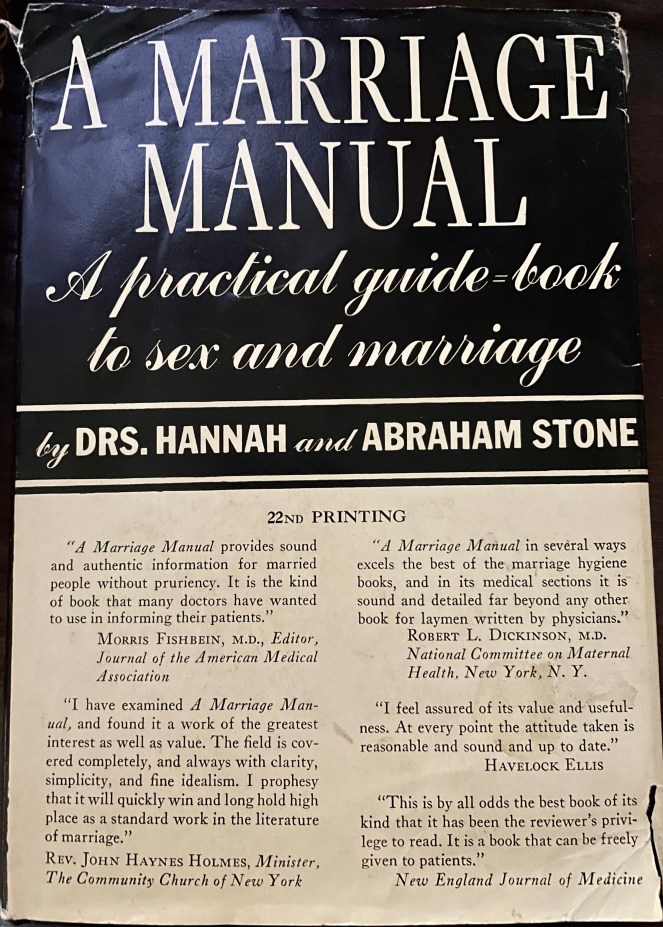
The title page says initial printing was 1935. Let’s review a bit of cultural history in United States 1930’s: folk are post WWI roaring 20’s, post Spanish Influenza pandemic, and post Depression, pre-WWII. Radios were showing up in most homes, and radio programs were hugely popular. Unemployment, particularly in the early ’30’s, was widespread. The New Deal had been recently implemented. The Dust Bowl was hitting the Great Plains. Eugenics has become the darling of the scientific world. Eugenics is the theory that humans can and should be bred similar to livestock, because there was a real fear that less intelligent, genetically deficient folk were having more babies than smart, rational, genetically superior specimens. I’m sure you can see the massive issues this sort of thinking leads to: eugenics may have started as “hey, could humanity selectively breed out things like spina bifida and epilepsy, and select partners for brainpower/physical traits/attitudes,” but ultimately that rabbit hole leads to a whole fucking host of -isms, with racism right at the top of the list. This is important for episode 1 of the review of this book, which requires a review of every fascinating chapter (not sorry), because Chapter 1 is titled “Fitness for Marriage.”
Important note: the book was written by a husband and wife set of doctors. The husband was Attending Urologist at Sydenham Hospital and Co-Director of the Marriage Consultation Center; The wife was Medical Director of the Birth Control Clinic Research Bureau and Co-Director of the Marriage Consultation Center. So these were medical experts in reproduction. They very clearly approach the questions about marriage and sex from a medical and scientific perspective, which was truly not what I expected. They dedicated the book to their daughter, which made me laugh. The whole book is written as a hypothetical interview session between an engaged couple’s questions and the doctors’ answers.
Ok. Chapter 1 notes are as follows:
- Marriage is between a man and a woman (recall, homosexuality is still illegal at the time). They go into the history of marriage a little bit, and conclude that the core reason for marriage is to make legitimate babies. Yeesh. Sucks if you’re infertile, huh? They do make a quick comment that if one or the other party is infertile a successful marriage may still happen, but it must be entered with both parties knowing they will never have biological offspring. I suppose that’s something.
- Fitness for marriage includes physical, psychological, and economic markers.
- “Hereditary and Environment” section, which is a whole discussion on nature vs nurture. They conclude a child’s potential is a mix of both, and even go into economic and social opportunities that can open doors for some while keeping others from reaching their full potential. So…social and economic (and racial) privilege was discussed in the 1930’s. Take note, anti-woke weirdos: this shit is not new.
- Physically: fertile and virile (although at this time female fertility wasn’t measurable in advance, male fertility was). There must be no venereal disease (gonorrhea or syphilis the only two that were checked for at the time, because they can be passed from the man to his wife and potential children. Please note: there is NO expectation a woman would have either VD because presumably she’s a virgin.) Eugenic preferences are also discussed here, and there’s commentary about why marrying a close relative is genetically not preferable (they discuss it from a science perspective, not a moral one). They say if the man can’t get it up or has low sperm count he shouldn’t get married, and if he has a disease he could pass along he shouldn’t get married. In this case, I’m using “get married” as he shouldn’t be having any sex at all. I wish they’d said that. They even comment on the NY marriage law of 1938 (this is the 22nd printing, so clearly a few things were added) requiring blood tests from both parties proving health 20 days before the marriage. Anyway, the physical fitness includes screening/interviewing for any hereditary diseases, but also comments on the genetics of eye color. I wonder how many husbands thought their wives were cheating because their baby’s eyes were blue when the parents’ eyes were brown? There’s even a paragraph or two about whether or not cancer can be inherited, which I found pretty interesting considering my last five years.
- Economic fitness: this goes into a place I 100% didn’t anticipate for the ’30’s, which shows you how much I don’t know about that period. The entire section is giving men a pass for not making enough to support a family yet (the historical benchmark for when a man should marry) and that if the couple is in love and wants to marry they should do so, knowing both parties will need to contribute to the household finances. So…she’s expected and encouraged to work after marriage if it’s for the household, but the unwritten implication of “until his career can support a family” is pretty clear about whether she should continue working after having babies. Still a negatory. I was just fussing the other day about the conservative stupidity of assuming all of history was like the 20 years or so after WWII when women were forced out of the workforce by returning GIs: to me, this whole section supports the notion that women have always worked and contributed to the home out of necessity or choice. That Leave it to Beaver bullshit is an anomaly blip, not the “good old days” misogynists think it was. I supposed that’s a different blog post.
- Psychologically: both parties must be ready to consider themselves married. This was directed, interestingly, at men, with an anecdote about a thrice-divorced man who simply refused to make the attitude change to be married. There is some discussion regarding love and companionship and willingness to compromise, which I found pretty unexpectedly refreshing as well. They discuss “psychopathic personalities (in both men and women), emotional derangements, individuals with abnormal sexual tendencies with conscious or subconscious homosexual inclinations” as issues preventing a successful marriage. Clearly they did not even conceive of successful LGBTQ+ marriages. But here’s the big one I loved, both for the frank way it was called out AND because it’s proof this has been issue forever: the thrice-divorced man? Yeah: the reason he wasn’t psychologically fit for marriage was because he couldn’t put his wife over his mother. “After several interviews it became quite evident that the basis of the maladjustment in this case was the man’s exaggerated attachment to his mother, who had always dominated his life, an attachment from which he could not free himself sufficiently to enter fully into a new association.” (Stone, 5)
What do you mean you made it this far in my massively book-length blog post? You deserve a cookie! Also, my new husband deserves a cookie because clearly we are unfit for marriage since we can’t reproduce. Yeah, I can’t roll my eyes hard enough here.
Ok, if you’re hanging in for this series of marriage and sex advice from the 1930’s, take heed: the next two chapters are the male and female reproductive systems, respectively. Try not to titter in embarrassment or discomfort: they have diagrams…which look almost exactly like your health class diagrams, perhaps with some missing parts. Again, the sheer amount of eye rolling may give me facial cramps.

 No Pithy Phrase
I’m sorry to hear about the passing of your mother-in-law. It is emotionally and physically hard to clean out years worth of memorabilia. Glad you found a treasure in all the things! I almost want to hunt down a copy of that book to read.
LikeLiked by 1 person